
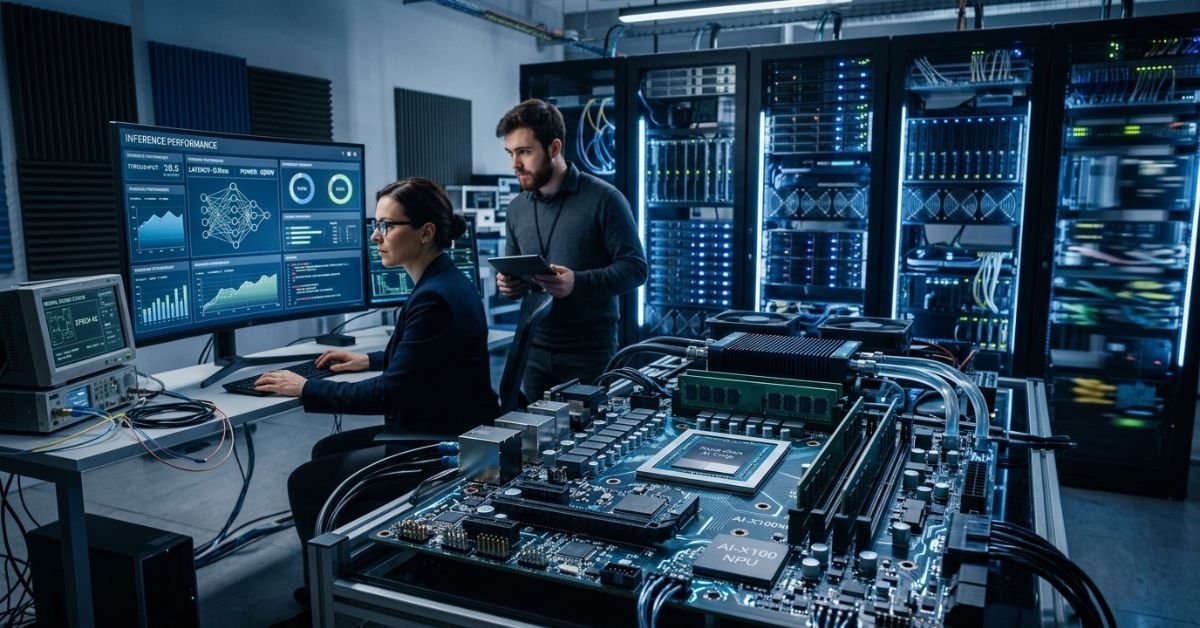
AI hardware revolves around accelerators optimized for the parallel math that powers neural networks. The big shift: moving beyond general-purpose CPUs to specialized designs that handle tensors, matrix multiplications, and inference efficiently.
Primary entities:
- GPUs (especially NVIDIA Blackwell/B200 series and upcoming Rubin)
- NPUs (Neural Processing Units in AI PCs and edge devices)
- TPUs (Google’s Tensor Processing Units)
- Custom ASICs (AWS Trainium, Microsoft Maia, Intel Gaudi)
- Specialized inference chips (Groq LPU, Cerebras WSE)
Secondary factors: High-Bandwidth Memory (HBM), chiplets, advanced packaging, power delivery, cooling infrastructure, and software ecosystems like CUDA.
Related terms you’ll see woven throughout: AI accelerators, inference vs. training hardware, edge AI, neuromorphic computing, TOPS (trillions of operations per second), and wafer-scale engines.
Major AI Hardware News and Releases in 2026
NVIDIA dominates headlines with the Blackwell platform ramping hard and the Rubin architecture on the horizon. Their B200 GPUs deliver massive leaps in performance, while rumors swirl around an Arm-based N1 CPU for data centers.
AMD pushes back strongly with the MI350/MI355 series, offering competitive memory capacity and inference speeds that appeal to cost-conscious hyperscalers. Intel’s Gaudi 3 gains traction in rack-scale deployments, especially paired with Xeon processors for enterprise inference.
Google continues iterating on TPUs (e.g., 8t for training, 8i for inference), Microsoft advances Maia 200 for efficient token generation, and startups like Cerebras and Groq carve niches with wafer-scale and ultra-fast inference solutions.
On the consumer side, CES 2026 highlighted AI PCs with powerful NPUs from Qualcomm, Intel (Core Ultra Panther Lake), and AMD (Ryzen AI 400 series), targeting 40-50+ TOPS for on-device AI.
Comparison of Leading AI Accelerators (Mid-2026)
| Chip/Platform | Type | Key Strength | Memory/Bandwidth | Best For | Notable Drawback |
|---|---|---|---|---|---|
| NVIDIA Blackwell B200 | GPU | Ecosystem + raw performance | High HBM3e | Training & inference | High power draw |
| AMD MI350X | GPU | Cost/performance balance | Up to 288GB HBM3e | Inference, hyperscale | Smaller software moat |
| Intel Gaudi 3 | ASIC | Open standards, efficiency | Strong I/O connectivity | Enterprise inference | Adoption curve |
| Google TPU v8 | ASIC | Scale in Google Cloud | Optimized tensor ops | Cloud workloads | Less flexible outside GCP |
| Groq LPU | Inference | Extremely fast tokens/sec | SRAM-heavy | Real-time LLM serving | Workload-specific |
| NPU (AI PCs) | Edge | Power efficiency | On-device unified memory | Local AI tasks | Lower peak performance |
Trends Shaping AI Hardware Right Now
- Memory Crunch: Up to 70% of high-end DRAM/HBM heading to AI data centers in 2026, driving shortages and price spikes.
- Edge & AI PCs: Shift toward on-device processing for privacy, latency, and lower costs. NPUs are becoming standard in premium laptops.
- Efficiency Over Raw Power: With energy demands exploding, chipmakers focus on better performance per watt, quantization, and specialized designs for agentic AI.
- Multi-Vendor Strategies: Organizations hedging with NVIDIA plus AMD/Intel/custom silicon to avoid lock-in and manage costs.
- Power & Infrastructure: Gigawatt-scale AI factories face real constraints around electricity, cooling, and land.
Myth vs. Fact
Myth: NVIDIA has an unbeatable monopoly forever. Fact: While their software ecosystem is strong, competitors are closing gaps in specific workloads, especially inference and cost-sensitive deployments.
Myth: More TOPS always means better AI performance. Fact: Real results depend on memory bandwidth, software optimization, and workload type raw numbers can mislead.
Myth: Edge AI will fully replace cloud training. Fact: They complement each other. Heavy training stays in data centers; inference and lightweight models move to the edge.
Statistical Snapshot
AI chip market projected to approach significant growth toward $500 billion territory in 2026 amid explosive demand. Data center spending on hardware (chips + infrastructure) is a major driver, with semiconductors overall heading toward $1 trillion globally. Annual failure rates and supply chain pressures highlight the need for diversified sourcing.
From the Trenches: What We’re Seeing in Practice
Having followed hardware deployments across enterprise and research setups through 2025 into 2026, the clearest pattern is that CUDA lock-in is real but not absolute. The common mistake? Betting everything on one vendor without piloting alternatives. Testing AMD MI300/350 clusters showed compelling TCO advantages for certain inference jobs, while NVIDIA still wins for rapid prototyping and broad model support. Power and cooling realities are biting harder than many expected those planning new clusters ignore them at their peril. Hands-on work with early NPU-equipped PCs confirms local AI is finally practical for everyday tasks like real-time editing or privacy-focused assistants.
FAQ
What is the biggest AI hardware news in 2026 so far?
NVIDIA’s Blackwell ramp and Rubin roadmap dominate, but AMD’s MI350 series, Intel Gaudi 3 deployments, and the explosion of NPUs in consumer AI PCs are making strong inroads. Memory supply constraints are another major story.
Should I buy an AI PC now?
If you do heavy local AI work (image generation, coding assistants, offline models), yes 2026 models with 40+ TOPS NPUs deliver noticeable benefits. For general use, wait for prices to stabilize unless you need the features today.
Is NVIDIA still worth it over alternatives?
For most training and broad compatibility, yes. For pure inference or cost optimization, evaluate AMD, Groq, or cloud custom silicon. Diversification is smart.
How important is HBM memory in AI hardware?
Critical. It’s the lifeblood for feeding massive models shortages are driving innovation in chip design and new memory technologies.
What’s the difference between training and inference hardware?
Training favors high-precision, scalable systems like GPUs/TPUs. Inference prioritizes speed, efficiency, and lower power where NPUs, LPUs, and optimized ASICs shine.
Will AI hardware shortages ease soon?
Not immediately. Demand outpaces supply through 2026-2027, especially for advanced memory and high-end accelerators. Plan accordingly.
CONCLUSION
From massive data center GPUs to efficient on-device NPUs, AI hardware in 2026 balances raw power with practicality like never before. NVIDIA sets the pace, but the ecosystem is healthier with real competition driving faster progress on efficiency and accessibility.
The next wave will likely emphasize even better edge capabilities, sustainable power solutions, and tighter hardware-software co-design. Keep an eye on your specific use case whether it’s cloud-scale training or local productivity and stay informed as things move fast.
CLICK HERE FOR MORE BLOG POSTS

Noah is a passionate content writer at Saxby, known for creating engaging and informative articles across a variety of topics. With a keen eye for detail and a reader-focused approach, he delivers high-quality content that blends clarity, research, and practical insights. Noah consistently aims to provide value-driven content that resonates with a global audience.