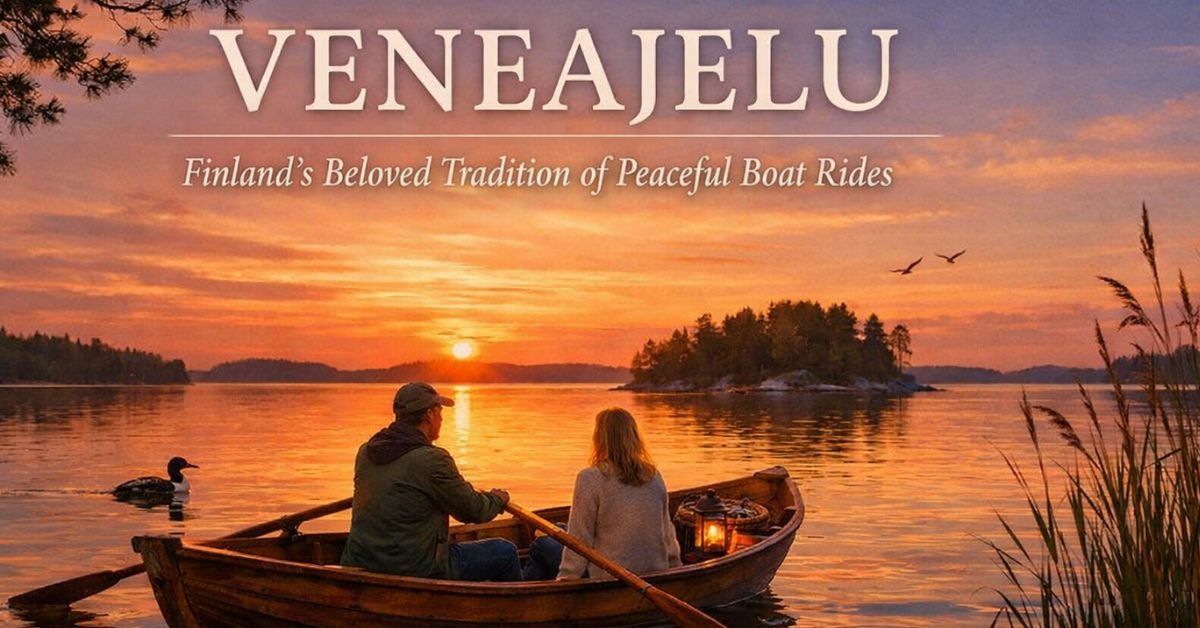
Imagine gliding across a glass-smooth lake as the sun dips low on the horizon, painting the sky in shades of gold and rose. The only sound is the soft dip of oars and the distant cry of a loon. Your phone is in your bag. Your worries are on shore. You are, in the truest sense, exactly where you need to be. This is veneajelu — and for millions of Finns, it is not simply a pastime. It is a philosophy.
This comprehensive guide explores every dimension of veneajelu: its profound cultural roots, the most stunning destinations in Finland to experience it, the different boats and styles of the excursion, practical planning tips, safety essentials, and the science of why drifting on water makes us feel so fundamentally, deeply human.
What is Veneajelu? More Than Just a Boat Ride
To translate veneajelu directly from Finnish is simple enough: vene means “boat,” and ajelu means “a casual ride” or “a leisurely drive.” Put them together and you get “a leisurely boat ride” — but this translation, while technically correct, misses everything that matters.
Veneajelu is not about reaching a destination. It is about the quality of presence during the journey. It is the Finnish art of slow, intentional time on the water — choosing to move at the pace of the current rather than the pace of modern life. Whether a fisherman rows out alone at dawn, a family motors between island picnic spots, or a couple drifts wordlessly as twilight deepens into midnight blue, veneajelu is defined by its spirit, not its speed.
| “Veneajelu is one of those Finnish concepts that defies perfect translation, because it is less an activity and more a state of mind — a conscious choice to step off the treadmill and simply be.” |
The Literal Meaning and Cultural Soul
The word ajelu is a softened, affectionate form of movement in Finnish — distinct from a purposeful drive or a race. It is the kind of ride you take not because you must, but because the act of riding is itself the reward. In this sense, veneajelu sits in the same cultural family as other Finnish concepts of intentional rest and nature connection: the meditative silence of a sauna, the solo contemplation of foraging in a pine forest, or the unhurried hours of a midsummer cottage weekend.
The boat — vene — has been central to Finnish life for millennia. Finland’s landscape is defined by its water: the country holds over 188,000 lakes, thousands of islands, and a dramatic Baltic coastline stretching across the southwest. Long before roads, waterways were the highways of the nation. Boats were tools of survival — for fishing, trade, and connection. Over time, as necessity gave way to comfort, the boat became something even more precious: a vessel for restoration.
Why Veneajelu is Central to Finnish Identity
To understand veneajelu, you must first understand the Finnish relationship with nature. This is a country where the seasons are extreme, the landscapes are ancient, and the cultural memory of living close to the land — and the water — runs very deep. Finns do not simply appreciate nature; they consider it an essential part of psychological wellbeing, a place to return to for balance, clarity, and healing.
A Tradition Passed Through Generations
The history of veneajelu as a leisure tradition traces back to the late 19th and early 20th centuries, when Finland’s urban middle class began spending summers at rural lake cottages — the iconic mökki. The mökki tradition, which persists powerfully today, involves retreating from city life to a simple lakeside cabin for weeks at a time. And what do you do at the mökki? You fish. You swim. You sit in the sauna. And you go out on the boat — not to race, not to compete, but simply to be on the water.
This mökki culture created the fertile ground in which veneajelu became a cultural institution. Children grew up learning to row before they could ride a bicycle. Grandparents passed their knowledge of local waters, secret fishing spots, and sheltered bays to the next generation. The boat became a site of family memory, folklore, and identity — a thread connecting generations across the lake.
Veneajelu as a Modern Antidote to Stress
Today, veneajelu has taken on new cultural urgency. In an age of hyper-connectivity, relentless productivity demands, and digital overload, the Finnish tradition of stepping into a boat and drifting away from the noise has become a form of conscious resistance — a deliberate choice to unplug and reconnect with the rhythms of nature.
Scientists have a term for the restorative power of water: Blue Mind. Coined by marine biologist Wallace J. Nichols, the Blue Mind theory describes the mildly meditative state human beings enter when near, in, on, or under water. Research shows that proximity to water lowers cortisol levels, reduces heart rate, boosts creativity, and induces the same neural patterns as mindfulness meditation. Finns may not have used the language of neuroscience to describe veneajelu, but they have understood its essence for centuries: water heals.
| Blue Mind Science: Studies show that spending time on or near water can lower cortisol (stress hormone) levels by up to 17%, enhance creativity, improve sleep quality, and promote a meditative state comparable to mindfulness practice. |
In this context, veneajelu is not a quaint tradition from another era. It is a profoundly relevant, scientifically grounded wellness practice — Finland’s gift to a stressed-out modern world.
The Complete Veneajelu Experience: A Step-by-Step Guide
There is no single right way to experience veneajelu, but certain rhythms and rituals have been refined over generations. Here is how to approach it for the most authentic, restorative experience.
1. Choose your water. Finland offers an astonishing variety: still inland lakes, island-laced archipelago routes, dramatic coastal passages, and gentle rivers. Your mood and experience level should guide you. Lakes are forgiving and serene; the archipelago is adventurous and scenic; coastal routes can be wild and invigorating.
2. Select your boat. Match the vessel to your vision. A rowboat is intimate and quiet, perfect for solo meditation or conversation. A small motorboat opens up wider waters and longer distances. A kayak brings you close to the surface, to the reeds and the wildlife. A sailing yacht carries you with the wind.
3. Leave the schedule behind. Veneajelu has no itinerary. You might plan a general direction — around the island, to the fishing spot, toward the sunset — but the route is yours to adjust. You may anchor somewhere beautiful for an hour simply because it is beautiful. This spontaneity is not laziness; it is the point.
4. Engage your senses. Listen to the water against the hull, the creak of the oarlocks, the call of the birds. Watch for the flash of a fish beneath the surface, the silhouette of a heron, the way the light shifts on the water as the sun moves. Veneajelu is a sensory immersion — lean into it.
5. Anchor and linger. The finest veneajelu moments often happen when you stop moving entirely. Find a sheltered bay, cut the engine or ship the oars, and simply drift. This is when the blue mind opens. This is when the conversation deepens, or the silence becomes companionable rather than empty.
6. Eat something simple and delicious. Few things pair better with veneajelu than makkara (Finnish sausage) grilled over a small fire on a rocky islet, smoked fish bought from a dockside seller, or simply good coffee from a thermos. Food tastes different on the water — richer, simpler, more satisfying.
7. Return slowly. As you head back, resist the urge to rush. The return journey is part of the ritual. Let the experience decompress naturally, and carry the calm with you as you step ashore.
Exploring Finland’s Best Veneajelu Destinations
Finland’s waterways are vast and varied. Each region offers a distinct character — from the serene, forest-mirrored inland lakes to the wild, wind-scoured passages of the outer archipelago. Here are the destinations that define the veneajelu experience.
Lake Saimaa: The Lake of a Thousand Islands
Lake Saimaa is the largest lake in Finland and the fourth largest in all of Europe, covering over 4,400 square kilometres of southern Finland. Its surface is an astonishing labyrinth of bays, narrows, channels, and islands — over 13,700 of them — offering virtually unlimited veneajelu routes. You could spend an entire summer exploring Saimaa and never repeat yourself.
Beyond its scale and beauty, Saimaa holds a rare ecological distinction: it is the only habitat in the world of the Saimaa ringed seal (Pusa hispida saimensis), one of the world’s most endangered freshwater seals. Spotting one on a rock, blinking in the sun, is an unforgettable veneajelu moment. The regional city of Savonlinna, with its magnificent island-set medieval castle Olavinlinna, makes an exceptional base for lake exploration.
Best for: Multi-day expeditions, fishing, wildlife watching, mixing lake cruising with cultural sightseeing.
The Turku Archipelago: A Mariner’s Paradise
The Turku Archipelago in southwestern Finland is one of the world’s largest archipelagos by number of islands, with over 20,000 islands, islets, and reefs stretching from the Finnish mainland toward the Åland Islands. This is veneajelu at its most dramatic and complex — a world of rocky shores, flower-strewn meadows, traditional fishing villages, and channels so labyrinthine that local knowledge is genuinely valuable.
The archipelago is best explored by motorboat or sailboat, with island-hopping as the natural format. Many islands have guest harbours, simple cafes, and even small saunas where you can moor for the night. The Archipelago Trail (Saaristotie) provides a curated route through the most scenic passages. Summer brings long days, wildflowers, and a palpable sense of living at the edge of the world.
Best for: Island-hopping, sailing, longer expeditions, experiencing authentic archipelago village life.
Helsinki’s Coastal Route: An Urban-Nature Blend
Many visitors are surprised to discover that one of Finland’s finest veneajelu experiences is available within minutes of the capital. Helsinki sits on a dramatic peninsula surrounded by an archipelago of over 300 islands, and the city’s relationship with the sea is intimate and central to its identity. The Helsinki City Hall steps lead directly to the Market Square, where boats have docked for centuries.
From Helsinki, you can rent a rowboat or kayak and explore islands that are nature reserves within sight of the city skyline — Suomenlinna sea fortress (a UNESCO World Heritage Site), Pihlajasaari for swimming, Seurasaari for open-air museum visits, or simply a quiet islet where you can sit in the sun undisturbed. The contrast of urban architecture visible in the distance and total natural quiet around you is uniquely Helsinki.
Best for: Day trips, tourists based in the city, those wanting easy access combined with genuine nature experiences.
Åland Islands: Sailing and Seafaring Heritage
The Åland Islands — an autonomous, Swedish-speaking archipelago of over 6,700 islands situated between Finland and Sweden in the Baltic Sea — represent veneajelu at its most maritime and historically resonant. The Ålanders have a deep seafaring heritage; this was once one of the world’s great centres of sailing ship construction and operation, and the culture remains deeply intertwined with the sea.
Sailing is the premier veneajelu form here, and the Åland archipelago is considered one of the finest sailing grounds in Northern Europe. The waters are sheltered yet diverse, the harbours are well-equipped, and the summer weather, while never guaranteed, can be spectacular. The capital Mariehamn houses the Pommern, one of the last intact sailing barques in the world, providing a powerful reminder of the region’s maritime soul.
Best for: Sailing enthusiasts, those interested in maritime history, longer Baltic cruising.
Lake Päijänne: Tranquil Southern Waters
Lake Päijänne, Finland’s second largest lake, stretches 119 kilometres through the central Finnish landscape and forms the spine of Päijänne National Park. Its shores are less populated than Saimaa’s, offering a greater sense of wilderness and solitude. The national park itself protects ancient forests, rare birdlife, and some of the purest water in the country — Helsinki’s tap water is drawn directly from Päijänne, filtered through a remarkable 120-kilometre tunnel.
The lake’s long, narrow form means that veneajelu here takes on a linear, expedition-like character — you might spend several days travelling from south to north, camping on uninhabited islands each night, foraging berries in the morning, and watching osprey hunt in the afternoon. This is veneajelu in its most elemental form.
Best for: Wilderness seekers, multi-day camping trips, birdwatching, those wanting solitude over scenery.
A Guide to Different Types of Veneajelu Boats
The choice of boat shapes every aspect of the veneajelu experience — its pace, its range, its intimacy, and its relationship to the water. Here is a guide to the main options.
Traditional Wooden Rowboats (Soutuveneet)
The traditional Finnish rowboat — soutuvene — is the soul of veneajelu. These elegant, often hand-crafted wooden vessels are designed for the calm waters of inland lakes, with a low profile, fine lines, and a lightness that allows them to glide beautifully on flat water. Rowing is a meditative, physical activity that connects you directly to the water’s rhythm in a way no motor can replicate.
Many old Finnish families still keep a traditional rowboat at the mökki, maintained across generations with the careful attention given to a beloved heirloom. For tourists, rowboats can be rented at most lake destinations for modest hourly or daily rates — and are the recommended choice for anyone who wants the most authentic, quiet, and connected veneajelu experience.
Modern Motorboats for Exploring
A small motorboat — typically a fibreglass or aluminium hull with an outboard engine between 5 and 50 horsepower — is the most versatile tool for veneajelu. It extends your range dramatically, making it possible to cross a large lake, reach remote islands, or explore a long stretch of coastline in a single day.
Finland has excellent infrastructure for motorboat rentals, with liveries at most major lake destinations, harbours, and holiday resorts. Engines up to 15 horsepower require no special licence in Finnish waters (for private use), making motorboat rental accessible to most visitors.
Kayaks and Canoes for the Adventurous
For those who want to move silently and intimately through Finland’s waterways, kayaking and canoeing offer a dimension of veneajelu that larger boats cannot match. Paddling allows you to enter reed beds, navigate narrow channels, approach wildlife without disturbance, and access shores where even a small motorboat cannot go.
Finland’s national parks are particularly well suited to kayak touring, with marked routes, camping spots, and fire pits on uninhabited islands. Multi-day kayak trips on Lake Saimaa or Päijänne represent some of the finest wilderness experiences available in Northern Europe.
Unique Experiences: Sauna Boats and Sailing Yachts
Finland has elevated the concept of the sauna boat — a floating sauna mounted on a pontoon or small barge — into a genuine veneajelu institution. These vessels allow you to alternately heat up in the wood-fired sauna, then plunge into the lake directly from the boat, floating in perfect contentment while the boat drifts slowly across the water. Many Finnish cities, including Helsinki, Tampere, and Turku, now offer sauna boat rentals for groups. It is an experience that perfectly distils the Finnish genius for combining simplicity with profound pleasure.
At the other end of the scale, chartering a sailing yacht for a week in the Turku Archipelago or the Åland Islands represents veneajelu in its most expansive form — sleeping aboard, waking in a different anchorage each morning, cooking in the galley, and navigating by wind. Yacht charter companies operate throughout coastal Finland and offer vessels from bareboat (self-skippered) to fully crewed options.
Veneajelu Through the Seasons: A Visual Journey
Finland’s dramatic seasonal shifts transform the veneajelu experience throughout the year. Each season has its own beauty, its own character, and its own specific rewards.
| Season | Conditions | Highlights | Best For |
| Spring (May–early June) | Ice melts by April–May; water clear and cold; nature awakening | Birdlife at peak activity; forests green and fresh; fewer crowds; affordable rates | Wildlife watching; peaceful exploration; budget travellers |
| Summer (June–August) | Peak season; long days (midnight sun in north); warm water; busy | Midnight sun; island picnics; swimming; wildflowers; full infrastructure | First-time visitors; families; sailing; island-hopping |
| Autumn (Sept–Oct) | Shorter days; cool, crisp air; ruska (autumn colours) in September | Spectacular foliage; excellent fishing; moose and elk visible; dramatic skies | Photography; fishing; experienced boaters; solitude seekers |
| Winter (Nov–March) | Lakes freeze; ice boating in some areas; Arctic light | Ice fishing; Northern Lights on the water; extraordinary silent landscapes | Adventure seekers; ice fishing enthusiasts; photographers |
The undisputed peak season for veneajelu is midsummer — the weeks around the summer solstice in late June, when Finland experiences the midnight sun. In the north of the country, the sun does not set at all for weeks. In the south, it dips briefly below the horizon before rising again, creating a prolonged golden twilight of extraordinary beauty. Going out on the boat at midnight, in full daylight, watching the sun hover at the waterline, is one of those travel experiences that stays with you permanently.
Autumn brings its own gift: the ruska, Finland’s breathtaking autumn colour display. Forests turn red, gold, and amber, reflected in the darkening lake water. The air is sharp and clear. The crowds have thinned. The fishing is excellent. Many experienced veneajelu practitioners consider September their favourite month on the water.
Essential Planning and Costs for Your Veneajelu
Planning a veneajelu experience requires some advance thought, particularly in peak summer months when boat rentals and guided tours in popular destinations can book out weeks in advance. Here is a practical guide to logistics.
Sample Pricing for Rentals and Tours
| Option | Typical Cost | Duration | Notes |
| Rowboat rental | €15–35 per hour / €60–120 per day | Hourly or daily | Most widely available; no licence required |
| Motorboat rental (small, under 15hp) | €40–80 per hour / €150–300 per day | Hourly or daily | No licence required; fuel often extra |
| Motorboat rental (larger) | €80–200 per hour / €300–600+ per day | Hourly or daily | May require boat licence; check with provider |
| Kayak or canoe rental | €20–40 per day / €80–200 per week | Day or multi-day | Multi-day packages available at national parks |
| Sauna boat rental (group) | €150–400 per 2–3 hours | Set duration | Typically for groups of 4–10 people |
| Guided veneajelu tour (half-day) | €60–120 per person | 3–4 hours | Includes guide, equipment, often refreshments |
| Guided multi-day expedition | €400–900 per person | 2–5 days | Includes accommodation, meals, full guiding |
| Yacht charter (bareboat) | €500–2500+ per week | Weekly | Requires sailing qualification; seasonal pricing |
Prices vary significantly by region, season, and provider. High season (July) commands premium rates; shoulder months (June and August) offer better value. Many operators offer multi-day discounts.
Boat Licence Requirements in Finland
Finland has a relatively accessible licensing framework for recreational boating. The key rules to know are:
- Boats with engines of 15 horsepower (approximately 11 kW) or less require no special licence for private use in Finnish waters — making small motorboat rental accessible to all tourists.
- Boats over 15 horsepower require the operator to hold a Finnish recreational craft licence or a recognised international equivalent. Many EU and international driving licences with a boat endorsement are accepted.
- Jet skis (personal watercraft) require a recreational craft licence regardless of engine size.
- Foreign visitors planning to captain a larger vessel should check with their rental operator in advance and carry documentation of any boating qualifications they hold.
- There is no minimum age for operating small, low-powered boats, but children should always wear life jackets and should not operate boats unsupervised.
How to Book: A Step-by-Step Process
- Research operators in your chosen destination at least 4–6 weeks before your travel dates in high season (June–August).
- Use regional tourism websites (e.g., VisitFinland.com, regional operators’ sites) or aggregator platforms to compare options.
- Confirm what is included: fuel, life jackets, maps, safety equipment — and what is not.
- Check cancellation policies carefully, as Finnish weather can change and you may want flexibility.
- For guided tours, read recent reviews and check that guides are certified and speak your preferred language.
- Book accommodation with easy water access — lakeside cottages, harbour-front hotels, or campgrounds with boat launching facilities.
What to Pack for a Perfect Veneajelu Day
Proper preparation significantly enhances the veneajelu experience. Finnish weather is famously variable — warm and sunny one hour, cool and showery the next — so packing in layers is essential. Here is a comprehensive checklist for a day trip.
Safety Essentials (Non-Negotiable)
- Life jacket or personal flotation device (PFD) for every person on board — required by Finnish law
- Charged mobile phone in a waterproof case or dry bag
- Paper map or downloaded offline charts of your area
- Basic first aid kit
- Torch or headlamp (especially for late evening outings)
- Whistle or signalling device
- Emergency contact information left with someone on shore
Clothing and Comfort
- Base layer of moisture-wicking thermal fabric — even in summer, Finnish lakes can be cold
- Mid-layer fleece or insulating jacket
- Waterproof outer layer (jacket and trousers)
- Hat and gloves for early morning or late evening outings
- Polarised sunglasses to reduce water glare
- Sun protection — SPF 30+ sunscreen and lip balm (water reflects UV radiation)
- Sturdy, non-slip footwear — boat shoes or rubber-soled trainers
Food, Drink, and Extras
- Thermos of hot coffee or tea (Finnish tradition and practical warmth)
- Water — at least 1.5 litres per person
- Makkara (Finnish sausages) and portable grill or foil packets for fire cooking
- Simple picnic foods: rye bread, cheese, smoked fish, fresh berries
- Reusable containers — to carry food and take all waste with you
- Binoculars for wildlife watching
- Camera with a waterproof case or action camera
- Insect repellent — Finnish lakes can be rich with mosquitoes in summer
- Dry bags for electronics, spare clothing, and food
- Small anchor or mooring rope for stopping
Traditional Food and Activities to Enhance Your Trip
Veneajelu is enriched by the rituals and tastes that accompany it. These are not mere accessories to the boat ride — they are integral to the experience, as distinctive and Finnish as the water itself.
Grilling makkara on an open fire. The Finnish sausage — makkara — grilled over a wood fire on a rocky islet is perhaps the single most iconic veneajelu ritual. The smell of woodsmoke and sizzling meat, the crunch of a charred skin, the taste of mustard on the side — this is sensory memory-making at its finest. Most organised campsites and many uninhabited islands have designated fire rings. Always use them and never light open fires in dry conditions or in prohibited areas.
Fishing. Finland’s lakes teem with pike, perch, zander, and trout. Recreational fishing from a boat is permitted under Finland’s Everyman’s Right with a simple national fishing management fee (required for those aged 18–64) and, for some species and areas, a regional licence. Fishing adds a purposeful dimension to veneajelu without sacrificing its essential unhurried quality.
Swimming (uinti). On warm summer days, jumping from the boat into the lake is one of life’s great simple pleasures. Finnish lake water, fed by rain and snowmelt through granite-filtered landscapes, is exceptionally clean and clear. Many Finns consider an impulsive swim from the boat — no beach required — an essential part of any proper veneajelu excursion.
Foraging. Finland’s Everyman’s Right (jokamiehenoikeus) allows anyone to pick wild berries and mushrooms anywhere in the country, including on islands reached by boat. Midsummer brings blueberries, lingonberries, and cloudberries to the island shores. Picking them — sun-warm, straight from the plant — and eating them with the lake in view is a veneajelu experience no restaurant can replicate.
Coffee culture on the water. Finns are among the world’s greatest coffee consumers, and the tradition of brewing strong, fresh coffee outdoors — in a battered tin pot over a fire, or poured from a thermos into a tin cup — is central to the Finnish outdoor experience. Coffee on the boat, in a quiet bay, is a ritual that asks nothing of you and gives back everything.
Essential Safety and Sustainability Practices
Veneajelu is a deeply peaceful activity, but Finnish waters can present genuine hazards — particularly for those unfamiliar with local conditions. Responsible boating is not merely a legal obligation; it is an expression of the same care for others and for nature that defines veneajelu at its best.
Non-Negotiable Safety Rules on Finnish Waters
- Life jackets must be worn by all children and available for all adults on board. In many conditions, wearing one at all times is simply wise — Finnish water temperatures, even in summer, can cause cold shock within minutes of immersion.
- Check the weather forecast rigorously before departure and monitor it throughout the trip. Finnish lake and coastal weather can change rapidly. If in doubt, stay ashore.
- Do not operate a boat under the influence of alcohol. Finnish law is strict on this point, and alcohol significantly impairs judgement, balance, and reaction time — dangers that are amplified on the water.
- Know your route and tell someone where you are going and when you expect to return. In remote areas, mobile coverage can be patchy.
- Carry a first aid kit and know how to use it. Basic water safety and CPR knowledge can be life-saving.
- Respect speed limits and no-wake zones near harbours, swimming areas, and other vessels. Wakes from passing boats can swamp small craft and disturb nesting birds.
- Carry sufficient fuel for your planned trip plus a reserve. Running out of fuel on a large lake in deteriorating weather is a serious situation.
Respecting Nature: A Guide to Eco-Friendly Boating
Finland’s natural landscapes are among the world’s most pristine, and Finns take their stewardship seriously. The principle of Everyman’s Right (jokamiehenoikeus) — the traditional legal right to access and enjoy nature freely — comes with a clear parallel obligation: leave no trace and cause no harm.
- Pack out all waste. There are no rubbish bins on most islands. Everything you bring in, you carry out. This is non-negotiable.
- Avoid disturbing nesting birds, particularly in spring and early summer. Many island-nesting species — eiders, gulls, terns — are highly sensitive to disturbance during breeding season. Keep a respectful distance.
- Consider electric motors where practical. Finnish lake tourism increasingly offers electric motor options, which produce no emissions, create minimal noise pollution, and allow wildlife to remain undisturbed.
- Do not discharge bilge water, sewage, or grey water directly into lakes or coastal waters. Finnish waterways are extraordinarily clean partly because of consistent responsible boating practices.
- Use marked fire rings when available, and only light open fires where explicitly permitted and conditions are safe. Extinguish fires completely before leaving.
- Respect private land. While Everyman’s Right allows landing on most shores, some areas are privately owned and marked accordingly. Overnight stays on private land require permission.
Frequently Asked Questions About Veneajelu
What does the Finnish word ‘veneajelu’ mean in English?
Veneajelu translates directly as ‘a leisurely boat ride’ — vene means ‘boat’ and ajelu means ‘a casual, unhurried ride.’ However, the word carries cultural meaning far beyond its literal translation, representing a Finnish philosophy of slow, intentional time on the water for relaxation and reconnection with nature.
Do I need a licence to drive a boat in Finland?
For boats with engines of 15 horsepower or less, no licence is required for private use in Finnish waters. For larger engines, a Finnish recreational craft licence or recognised international equivalent is necessary. Always confirm requirements with your rental provider.
How much does it cost to rent a boat for veneajelu?
Costs vary by boat type and duration. Rowboats typically rent for €15–35 per hour or €60–120 per day. Small motorboats run €40–80 per hour. Guided half-day tours cost approximately €60–120 per person. Multi-day expedition packages range from €400–900 per person including accommodation and meals.
What is the best time of year for a boat ride in Finland?
The peak season is June–August, with the midnight sun being a highlight of late June and July. September offers spectacular autumn colours and excellent fishing with fewer crowds. Spring (May) provides birdwatching opportunities and affordable rates. Each season has distinct appeal — your ideal time depends on your priorities.
Can you do veneajelu in Helsinki?
Absolutely. Helsinki’s surrounding archipelago of over 300 islands offers excellent boating within minutes of the city centre. Rowboats and kayaks are available for rental at several city harbours, and guided tours depart from the Market Square. Islands like Suomenlinna, Pihlajasaari, and Seurasaari are all accessible and well worth exploring.
What should I bring on a veneajelu trip?
Essentials include a life jacket, layered weatherproof clothing, sunscreen, a charged phone in a waterproof case, water and food (including coffee!), a paper map of the area, and a basic first aid kit. For longer trips, add a dry bag for electronics, insect repellent, binoculars, and a portable grill or foil for cooking on shore.
Is it safe to go boating in Finland?
Finnish waters are generally safe when approached responsibly. Key practices include wearing a life jacket, checking weather forecasts, not drinking alcohol while operating a boat, knowing your route, and informing someone of your plans. Conditions can change quickly, particularly on large lakes and coastal waters, so vigilance is essential.
What is Everyman’s Right and how does it apply to boating?
Everyman’s Right (jokamiehenoikeus) is a traditional Finnish legal principle giving everyone the right to access and enjoy nature freely, regardless of land ownership. For boaters, this means you may land on most shores, pick berries and mushrooms, and camp briefly on most islands. It comes with the obligation to leave no trace, respect wildlife, and not disturb private property.
Are there guided veneajelu tours for tourists?
Yes — guided tours are widely available throughout Finland, particularly in major lake and archipelago destinations. Options range from half-day tours with a local guide to multi-day expedition packages including camping, meals, and full equipment. Guided tours are an excellent option for first-time visitors or those unfamiliar with local waters.
What is a Finnish sauna boat?
A sauna boat is a vessel with a wood-fired sauna cabin built into it, typically on a pontoon or barge. Users alternate between steaming in the sauna and swimming directly from the boat in the lake — one of Finland’s most indulgent and deeply Finnish experiences. Sauna boats are available for group rental in Helsinki, Tampere, Turku, and many lake destinations.
Conclusion: Your Own Veneajelu Awaits
There is a moment that every veneajelu practitioner knows. You are out on the water — it might be a glassy lake at dawn, a wind-ruffled channel between islands at noon, or a sunset-gilded bay in the long Finnish evening. The boat is still. The world is quiet. And for a few extraordinary minutes, you feel exactly the right distance from everything that ordinarily presses on you.
This is the gift that veneajelu offers — not adventure in the conventional sense, not excitement or spectacle, but something rarer and more durable: a quality of presence, a depth of calm, a reconnection with the slow rhythms of water and sky and season that our ancestors understood as essential to human flourishing.
Finland’s waterways — its 188,000 lakes, its thousands of islands, its Baltic coastlines and quiet rivers — are waiting for you. A boat, a few hours, and a willingness to drift: that is all it takes. Everything else, veneajelu will provide.
| Ready to experience veneajelu? Start planning your Finnish water adventure at VisitFinland.com or explore regional boat rental providers in your chosen destination. Book early for summer — the best boats fill up fast. |