
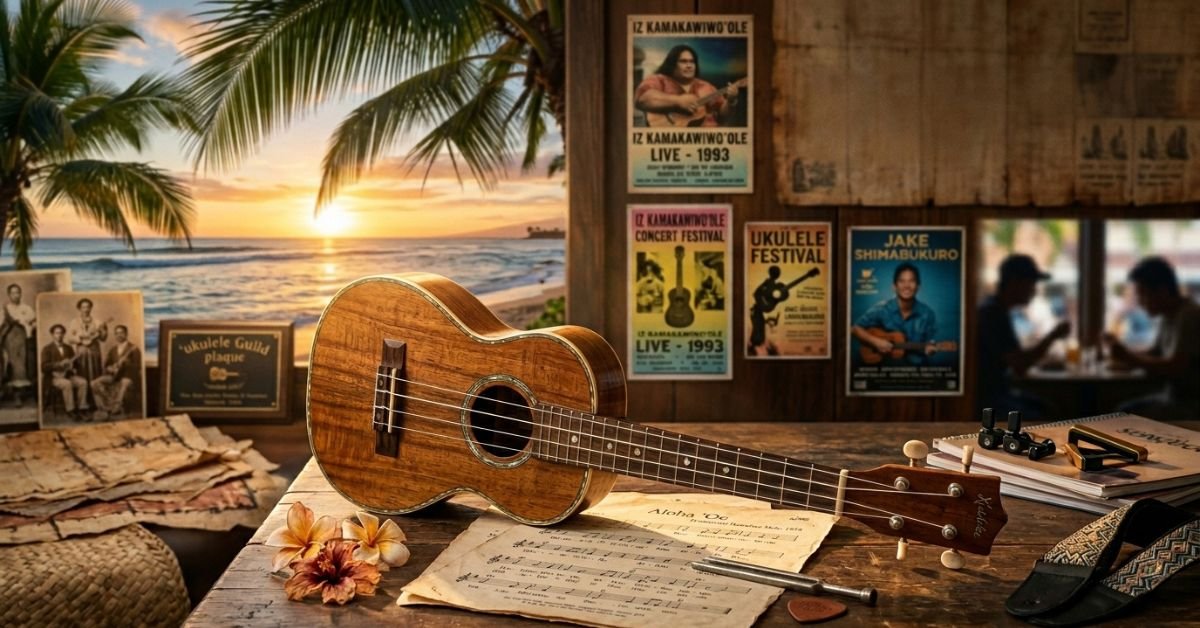
Ukulele didn’t start in Hawaii. Its DNA traces to small guitar-like instruments from Portugal, specifically the island of Madeira. In the late 1870s, economic hardship in Madeira pushed many residents toward Hawaii’s booming sugar plantations.
On August 23, 1879, the ship SS Ravenscrag arrived in Honolulu carrying Portuguese immigrants. Among them were cabinet makers Manuel Nunes, José do Espírito Santo, and Augusto Dias. These craftsmen brought instruments like the machete (or braguinha), cavaquinho, and rajão. They soon began modifying them using local woods like koa, creating the hybrid we now call the ukulele.
Rise in Hawaiian Culture
The ukulele found royal patronage that cemented its place in Hawaiian identity. King David Kalākaua, known as the Merrie Monarch, loved the instrument and incorporated it into court performances and hula. His sister, Queen Liliʻuokalani, also played and supported its spread.
This royal endorsement helped transform it from a novelty into a cultural staple. By the 1880s–1890s, it featured prominently in Hawaiian music, blending with traditional chants and mele.
Global Spread and American Popularity
The ukulele hit the mainland U.S. big in 1915 at the Panama-Pacific International Exposition in San Francisco. Hawaiian pavilions showcased the instrument, sparking a craze. Tin Pan Alley tunes and vaudeville acts followed.
Key waves of popularity:
- 1920s Jazz Age: Ukuleles became affordable and fashionable.
- 1950s–60s: Arthur Godfrey and Tiny Tim kept it in the spotlight.
- 1970s–90s: A dip during rock dominance, followed by Hawaiian cultural revival.
- 2000s–2020s: Internet virality, with artists like Jake Shimabukuro introducing it to new generations via YouTube.
Types and Evolution of the Ukulele
Ukuleles come in four main sizes today, each with distinct tonal qualities:
- Soprano: Original size, bright and classic “uke” sound.
- Concert: Slightly larger, warmer tone with more playability.
- Tenor: Versatile for soloing and strumming.
- Baritone: Deeper, guitar-like sound, often tuned like the bottom four guitar strings.
Modern innovations include electric ukuleles, carbon fiber models for travel, and custom builds using exotic woods.
Comparison Table: Ukulele Sizes
| Size | Scale Length | Typical Tuning | Best For | Tone Character |
|---|---|---|---|---|
| Soprano | 13″ | GCEA (High G) | Beginners, traditional | Bright, crisp |
| Concert | 15″ | GCEA | All-around play | Balanced, fuller |
| Tenor | 17″ | GCEA or DGBE | Soloing, fingerstyle | Rich, projective |
| Baritone | 19″ | DGBE | Guitarists, deeper music | Warm, resonant |
Myth vs. Fact
Myth: The ukulele was invented in Hawaii. Fact: It evolved in Hawaii from Portuguese instruments, but its roots are firmly in Madeira, Portugal.
Myth: All ukuleles use the same tuning. Fact: While GCEA (high or low G) dominates, variations exist, especially on baritones and custom models.
Myth: The ukulele is just a toy instrument. Fact: Virtuosos like Jake Shimabukuro and Taimane Gardner prove it can handle complex jazz, rock, and classical arrangements.
Myth: It only belongs in Hawaiian music. Fact: It appears across genres — indie, pop, folk, and more.
Statistical Proof and Cultural Impact
Ukulele sales in the U.S. saw massive growth, with roughly 1.7 million units sold annually in recent years. The instrument’s accessibility has made it a favorite in music education programs worldwide.
Its cultural footprint includes appearances in films, viral hits (Israel Kamakawiwoʻole’s “Somewhere Over the Rainbow”), and community jams that foster connection.
EEAT Insights: Lessons from Decades in Music Education
After years working with musicians and teaching instruments across genres, one truth stands out: the ukulele’s greatest strength is its approachability. In 2025 workshops, beginners often progress faster on ukulele than guitar, building confidence quickly. Yet the common mistake is underestimating its depth — treating it as a novelty rather than exploring its full potential for expression. Hands-on experience with vintage and modern builds shows how construction details (bracing, wood choice) dramatically affect playability and tone.
FAQs
Where did the ukulele originally come from? It evolved in Hawaii from Portuguese instruments brought by immigrants from Madeira in 1879. The name and cultural integration are Hawaiian, but the foundational designs are Portuguese.
Who invented the ukulele? No single inventor, but Madeiran cabinetmakers Manuel Nunes, Augusto Dias, and José do Espírito Santo are credited with the earliest Hawaiian versions in the 1880s.
Why is the ukulele called “jumping flea”? In Hawaiian, ʻuku means flea and lele means to jump — describing the quick finger movements across the strings.
How has the ukulele’s popularity changed over time? It boomed in the 1910s–1920s, stayed relevant through mid-century TV, dipped with rock music, and exploded again in the digital age through social media and easy learning resources.
Is the ukulele still popular in 2026? Yes. Its portability, low cost, and versatility keep it thriving in education, therapy, and professional music scenes globally.
What are the main types of ukulele? Soprano, concert, tenor, and baritone. Each offers different sizes, tones, and playing styles suitable for various skill levels and music genres.
CONCLUSION
The ukulele’s journey connects Portuguese craftsmanship, Hawaiian innovation, royal patronage, American entertainment, and digital revival. Key entities like the machete, King Kalākaua, and modern players such as Jake Shimabukuro illustrate its remarkable adaptability.
CLICK HERE FOR MORE BLOG POSTS

Noah is a passionate content writer at Saxby, known for creating engaging and informative articles across a variety of topics. With a keen eye for detail and a reader-focused approach, he delivers high-quality content that blends clarity, research, and practical insights. Noah consistently aims to provide value-driven content that resonates with a global audience.