
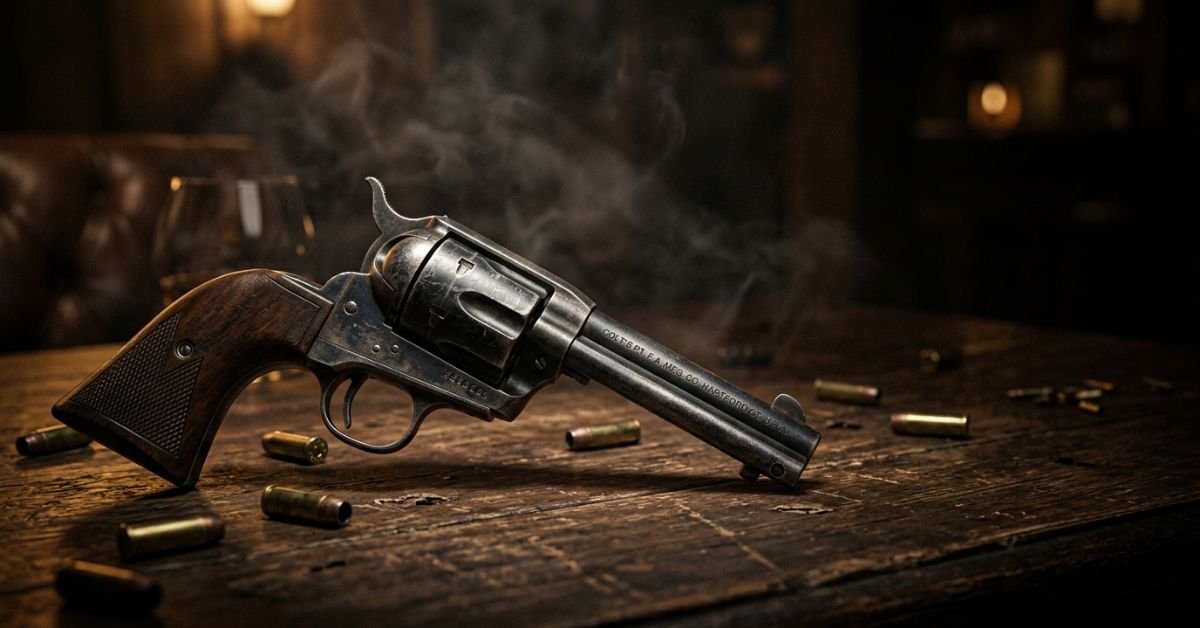
Revolver and it feels solid that unmistakable click of the cylinder, the weight in your hand, the sense that it’s built to work when you need it. Whether you’re drawn to the history, reliability, or the simple mechanical beauty, revolvers occupy a special place in firearms culture that semi-autos haven’t fully replaced.
In 2026, with new models launching and renewed interest in their simplicity, revolvers are experiencing a quiet renaissance. This guide covers their origins, how they work, key players in their story, different types, comparisons to other handguns, myths, and practical insights for anyone curious or considering one.
The Origins and History of the Revolver
The modern revolver traces back to Samuel Colt, who patented his design in 1836. His Colt Paterson was the first practical repeating handgun with a revolving cylinder. Earlier concepts existed, but Colt made them reliable and manufacturable.
The revolver truly exploded during the American Civil War and the Old West era. The Colt Single Action Army (1873 model), nicknamed “Peacemaker,” became legendary. It chambered powerful cartridges and symbolized frontier justice.
European contributions, like the British Adams revolver, added double-action mechanisms earlier. By the late 19th century, revolvers dominated law enforcement and military sidearms until semi-automatics gained ground in the 20th century.
How a Revolver Works: Mechanics Explained
At its core, a revolver is elegantly simple. The cylinder holds multiple cartridges (usually 5–8). When you pull the trigger or cock the hammer:
- The cylinder rotates to align a fresh chamber with the barrel.
- The hammer strikes the firing pin, igniting the primer.
Single-action vs double-action:
- Single-action: You manually cock the hammer; trigger only releases it.
- Double-action: Trigger pull cocks and releases the hammer in one motion.
This mechanical directness means fewer moving parts than most semi-autos, leading to higher inherent reliability with problematic ammunition.
Spent cases stay in the cylinder until manually ejected, unlike semi-autos that eject automatically.
Iconic Revolver Models and Evolution
Some revolvers became cultural icons:
- Colt Single Action Army: Old West staple.
- Colt Python: Elegant .357 Magnum with smooth action.
- Smith & Wesson Model 10: Ubiquitous .38 Special service revolver.
- Ruger Blackhawk: Modern single-action favorite.
- Smith & Wesson 686: Versatile .357 Magnum.
In 2026, manufacturers are reissuing classics without controversial internal locks and introducing new options in various calibers.
Types of Revolvers
Revolvers vary by size, action, and purpose:
- Snub-nose: Short barrels for concealed carry.
- Service/medium frame: Balanced for duty or home defense.
- Large frame: Magnum calibers for hunting or power.
- Single-action (SA) vs Double-action (DA) vs Double-action only (DAO).
Modern materials include scandium frames for lighter weight and titanium cylinders.
Revolver vs Semi-Automatic Comparison Table
| Aspect | Revolver | Semi-Automatic Pistol |
|---|---|---|
| Capacity | 5–8 rounds | 7–17+ rounds |
| Reliability | Excellent; tolerant of neglect | Good, but more prone to jams |
| Reload Speed | Slower (speed loaders help) | Faster with magazines |
| Trigger Feel | Often heavier DA pull | Lighter, more consistent |
| Maintenance | Simple, fewer parts | More complex |
| Power | Handles hot magnum loads well | Typically 9mm/.40/.45 |
| Safety | No external safety needed often | External safeties common |
Myth vs Fact
Myth: Revolvers never jam. Fact: They are very reliable but can fail due to user error, poor ammo, or mechanical wear (though less often than semis).
Myth: Revolvers are outdated and less accurate. Fact: Fixed barrel design often gives excellent inherent accuracy; many competitive shooters still prefer them.
Myth: All revolvers are powerful “Dirty Harry” magnums. Fact: They come in everything from .22 LR to .44 Magnum and beyond.
Myth: Revolvers are safer for beginners. Fact: They have a long, heavy trigger pull that can help prevent accidents, but training is essential for any firearm.
Statistical Proof and Modern Context
Revolvers make up about 30% of handguns in U.S. civilian ownership (roughly 43 million out of 145 million handguns). While semi-autos dominate new sales, revolvers maintain strong loyalty for their simplicity.
In 2026, the market shows renewed interest with dozens of new and revived models hitting stores.
EEAT Insights: From Hands-On Experience
After years evaluating and handling firearms across eras, the pattern is clear: people who dismiss revolvers as old tech often haven’t spent time with a well-tuned one. In 2025 range sessions, a classic no-lock S&W Model 19 still outshot many modern pistols for new shooters because of its straightforward operation and confidence-inspiring feel. The biggest mistake? Choosing based on internet hype instead of matching the tool to your needs and training level. Real-world durability testing shows properly maintained revolvers can last generations.
FAQs
What is the difference between a revolver and a pistol?
A revolver uses a rotating cylinder to hold and fire rounds. A pistol (usually meaning semi-automatic) uses a magazine and reciprocating slide. Revolvers are mechanically simpler and more reliable under adverse conditions.
Are revolvers still good for self-defense in 2026?
Yes, especially for those who prioritize reliability over capacity. Modern defensive loads make .38 Special or .357 Magnum very effective. They excel for users who may not train as frequently.
Who makes the best revolvers today?
Smith & Wesson, Ruger, Colt, and Taurus offer strong options across price points. Choice depends on intended use heritage brands for classics, others for value or innovation.
How do you reload a revolver quickly?
Use speed loaders or moon clips. Practice is key. Many prefer them for home defense where reloads are less critical than initial reliability.
What caliber is best for a revolver?
357 Magnum (shoots .38 Special too) is extremely versatile. .38 Special for lighter recoil, or .44 Magnum for serious power. Match to your recoil tolerance and purpose.
Do revolvers have safeties?
Many don’t need external ones due to heavy trigger pulls. Some modern ones include hammer blocks or transfer bars for drop safety.
CONCLUSION
The revolver connects Samuel Colt’s innovation, Wild West lore, law enforcement history, and today’s practical users. Key elements rotating cylinder, single/double action, legendary models like the Python and Blackhawk define its enduring appeal.
CLICK HERE FOR MORE BLOG POSTS

Noah is a passionate content writer at Saxby, known for creating engaging and informative articles across a variety of topics. With a keen eye for detail and a reader-focused approach, he delivers high-quality content that blends clarity, research, and practical insights. Noah consistently aims to provide value-driven content that resonates with a global audience.